Poison ivy (Toxicodendron radicans) is notorious for causing painful, itchy rashes and blisters on contact, leading many to avoid any plant with three leaflets. However, this caution often results in harmless plants being unfairly shunned. Knowing the differences between poison ivy and its lookalikes can prevent unnecessary worry and help you identify safe, even edible, plants in your garden or on a hike.
To distinguish poison ivy, note that its leaves are composed of three leaflets that alternate along the stem. The leaflets can be glossy or dull, with jagged or smooth edges, and each ends in a pointed tip. The central leaflet has a longer stem than the side leaflets. Poison ivy grows as a vine, either along the ground or climbing trees and structures, and may have a reddish tinge. Its leaves change color with the seasons, from green to yellowish-orange or deep red, and it may produce small greenish flowers that turn into berries in fall and winter.
Here are 11 plants that are often mistaken for poison ivy but are generally safe to touch.
Boxelder
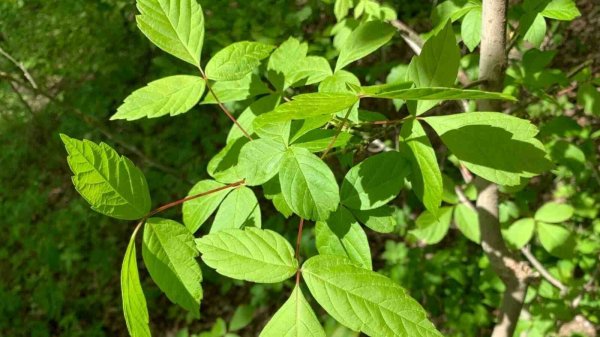
Boxelder (Acer negundo), a maple tree native to the U.S., has leaves that appear in groups of three when young, resembling poison ivy. However, boxelder leaves are positioned opposite each other on the stem, whereas poison ivy leaves alternate. Boxelder stems may have a bluish tint, unlike the reddish stems of poison ivy. As the tree matures, it develops more leaflets and a distinct trunk, making it easy to tell apart. Boxelders are adaptable and thrive in USDA Zones 2–9 with minimal care.
Blackberry
Blackberry (Rubus spp.) is a popular edible shrub that can be confused with poison ivy due to similar leaf shapes. However, blackberry stems are often thorny, and its leaflets usually come in groups of four or five, not always three. When fruiting, blackberries are large and dark, unlike the small, light-colored berries of poison ivy. Blackberries are safe to eat and can provide a harvest in fall.
Raspberry
Wild raspberries (Rubus idaeus) are common across the U.S. and often grow near poison ivy, leading to confusion. Raspberry leaflets have more pronounced serrated edges and a rougher texture than poison ivy's smooth leaves. The underside of raspberry leaves is a lighter, greyish green. When fruiting, raspberries are red and distinct from poison ivy berries. They are safe to eat, but only pick ripe berries, as they won't ripen after being picked.
Virginia Creeper
Virginia creeper (Parthenocissus quinquefolia) is a fast-growing vine often mistaken for poison ivy. Its name, meaning 'five-leaved,' indicates its leaflets usually come in groups of five, though young plants may have three. Virginia creeper leaflets attach directly to the central branch, unlike poison ivy's leaflets which have their own stems. Its berries are deep blue, not greenish-white. While Virginia creeper is not poisonous to touch, its berries are not edible and can cause stomach upset if ingested.
Hog Peanut
Hog peanut (Amphicarpaea bracteata) is another vine that grows near poison ivy. Its stems are thinner and more delicate than poison ivy's, and its leaves are rounder at the base, described as egg-shaped. Hog peanut leaves are slightly fluffy to the touch, but touching them is not recommended for identification. It is harmless to humans.
Boston Ivy
Boston ivy (Parthenocissus tricuspidata), a relative of Virginia creeper, is native to East Asia and often climbs walls in gardens. Its leaves can be compound or simple, sometimes with fused side leaflets, resulting in two leaflets instead of three. The leaf margins are always serrated, unlike poison ivy's irregularly jagged or smooth edges. Boston ivy is toxic if ingested, and some people may develop a rash from touching it, so caution is advised.
Jack-in-the-Pulpit
Jack-in-the-pulpit (Arisaema triphyllum) is a rare woodland plant with unique flowers and berries. When young, its leaves may look like poison ivy, but they are always smooth and grow on long, upright stems, not along a vine. The leaves are larger and wider, and the center vein does not reach the leaf edge, unlike poison ivy. It produces red berries in late summer and is safe to touch.
Strawberry
Wild strawberries (Fragaria spp.) have leaves with three leaflets, similar to poison ivy, but their edges are more jagged and the leaf tips are rounded, not pointed. Mock strawberry (Duchesnea indica) has a yellow tinge to its leaves and produces tasteless fruits. While mock strawberry is invasive and best removed from gardens, it is not dangerous.
Jewelweed
Jewelweed (Impatiens capensis) is often considered the antidote to poison ivy, as its stem juice is used to treat poison ivy rashes. It lacks the triplet leaflets, with leaves appearing in larger groups on long stems. Jewelweed has lighter green stems without the reddish tint, and in spring it produces orange blooms. It is safe to touch and beneficial for treating itching.
Bushkiller Vine
Bushkiller vine (Cayratia japonica) is an invasive plant with leaflets in groups of five, the center leaflet being longer. The extra two leaflets are smaller and rounder. While it can quickly overtake a garden, it is not dangerous to touch. If found, it should be removed and destroyed to prevent spreading.
Fragrant Sumac
Fragrant sumac (Rhus aromatica) is a shrub that grows to about 4 feet tall and spreads wide. Its leaf stems are very short or absent, unlike poison ivy's long center stem. It cannot climb like poison ivy. Fragrant sumac produces yellow blooms and red berries that are edible raw and have an acidic taste. Some people use the berries to make drinks or tea.
If you encounter a plant you suspect is poison ivy, it's wise to err on the side of caution. However, with a bit of observation, you'll likely find that many lookalikes are harmless and may even be beneficial additions to your garden or foraging basket.