The citrus leafminer, a tiny moth known scientifically as Phyllocnistis citrella Stainton, has established itself as a notable pest in citrus-growing regions worldwide since its initial detection in Florida in 1993. The insect, which creates distinctive serpentine tunnels in young leaves, poses a particular risk to nursery stock and young trees, though mature orchards typically see little impact on fruit yield. Growers from Texas to southern California are contending with this invasive pest, which originated in Asia and has spread through the global citrus trade.
The adult moth is small, measuring about 2 mm in length with a wingspan of roughly 5 mm, and is characterized by silvery-white wings marked with brown streaks and a black spot at each wingtip. Nocturnal in habit, adults are most active from dusk to dawn, and females lay up to 50 eggs on the underside of young leaves, usually near the midrib or veins. The eggs, which resemble tiny water droplets, hatch in 4 to 10 days depending on temperature, and the resulting larvae immediately begin tunneling beneath the leaf surface.
Life Cycle and Regional Variations
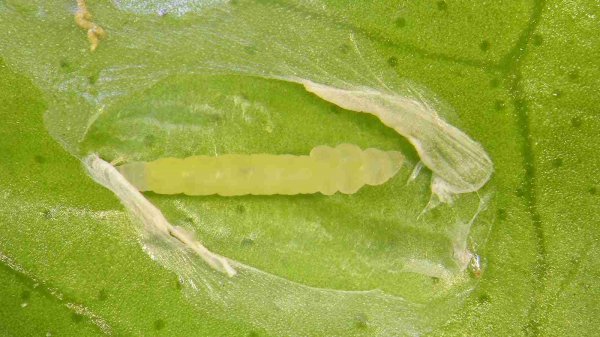
The larval stage consists of four instars, with three feeding stages and one non-feeding prepupal stage, each lasting 10 to 19 days. After the final instar, the larva exits the mine, causing the leaf edge to curl, and pupates within that curl. The pupal stage lasts 8 to 20 days before the adult emerges, and mating begins almost immediately. The number of generations per year varies significantly by location: Florida sees a new generation roughly every three weeks, California experiences seven to eight generations annually, and Pakistan has recorded up to 16 generations in a single year.
Leafminers are most active during new leaf flushes, which typically occur in late summer and early fall. However, in coastal California, where lemon trees flush continuously, infestations can persist year-round. The damage is most visible as shallow, winding tunnels on the leaf surface, with a thin dark line of frass (excrement) visible inside. Interestingly, larvae never cross their own or others' tunnels, a behavioral quirk that creates a distinctive pattern.
Management Strategies: Cultural and Biological
For mature trees, leafminer damage is often more cosmetic than harmful, and the best approach is frequently to leave the affected leaves alone. However, for young trees, the loss of photosynthetic tissue can stunt growth, and the wounds created by tunneling can make trees more susceptible to citrus canker. Therefore, management focuses on reducing pest populations while protecting the natural enemies that keep them in check.
Cultural controls include hand-picking heavily infested leaves and discarding them in soapy water to drown the larvae. Pruning should be minimal, as excessive pruning can stimulate new growth that attracts egg-laying moths. Similarly, applying nitrogen fertilizer during a heavy infestation can worsen the problem by encouraging flushing. Sex pheromone sticky traps are useful for monitoring adult populations, though they only capture males and are not a control method.
Biological control is a cornerstone of leafminer management. Several species of parasitic wasps, including Ageniaspis citricola and Cirrospilus coachella, lay their eggs inside leafminer tunnels, and their larvae consume the leafminer larvae. In Florida, natural enemies are responsible for over 50% of leafminer larval mortality, underscoring their importance. These beneficial wasps are often already present in citrus regions, so introducing them is rarely necessary.
Horticultural oils, such as neem oil, are sometimes applied to developing leaves during flush periods. These oils can inhibit egg hatching, but spraying must continue for 10 to 14 days until leaves harden, and should be stopped when temperatures exceed 80°F (27°C). Chemical insecticides are generally not recommended, as they are often ineffective against larvae protected beneath the leaf surface and can harm beneficial insects.
Leafminers thrive in conditions of 75 to 80°F (24-27°C) with relative humidity above 60%. In inland California, high summer temperatures naturally suppress populations, while cooler coastal areas are more favorable. With rising global temperatures, the pest's range may expand, particularly in spring and autumn, making ongoing monitoring and adaptive management important for citrus growers.